Few debates in modern Rolex collecting carry as much weight as the GMT-Master II “Pepsi” versus “Batgirl.” Both sit on the same 126710 generation foundation, both share the Caliber 3285, and both wear the Jubilee bracelet with ease. Yet on the wrist, they couldn’t feel more different.
One leans into heritage and aviation romance. The other feels like it was built for today’s traveler who wants discretion without losing presence. Choosing between them is less about specs and more about personality.
The Heritage Icon: GMT-Master II “Pepsi” (126710BLRO)
The “Pepsi” is the watch most people picture when they hear GMT-Master. Its red-and-blue bezel traces back to the original 1954 GMT-Master, created for Pan American World Airways pilots navigating long-haul flights across time zones. That origin still defines how the watch is perceived today – functional, yes, but also deeply tied to the golden age of aviation.
When Rolex reintroduced the steel Pepsi in 2018 on a Jubilee bracelet, demand surged almost immediately. Waiting lists followed, as they often do, but in this case the reaction felt almost predictable. It wasn’t just nostalgia – it was recognition.
The defining feature is, of course, the Cerachrom bezel. Producing the bi-color red and blue ceramic isn’t straightforward; each half requires separate treatment and multiple firing processes to achieve stable coloration. The result isn’t just technical complexity but subtle variation in how the colors behave under different lighting conditions. In daylight, it feels crisp and almost playful. Under softer indoor light, it becomes deeper and more restrained.
This is where the Pepsi’s character really shows. It’s not trying to be subtle. It carries history on its sleeve and expects the wearer to appreciate it.
The Modern Contender: GMT-Master II “Batgirl” (126710BLNR)
It evolved from the original black-and-blue “Batman” GMT, but the shift to the Jubilee bracelet softened its character significantly. That change alone altered how the watch sits in Rolex’s lineup. It stopped feeling purely tool-like and started leaning into everyday versatility.
The black-and-blue Cerachrom bezel is less theatrical than the Pepsi’s color split. The black portion blends into the dial almost seamlessly, which makes the blue half stand out in a quieter, more controlled way. It doesn’t announce itself across a room, but it rewards attention up close.
In practice, that makes it an easy watch to live with. It disappears under a cuff, works in formal settings without feeling out of place, and still carries enough visual interest to avoid being boring. It’s the GMT you wear when you don’t want to think too hard about what you’re wearing – but still care about what it says.
Shared Engineering, Different Personalities
Both models run on Rolex’s Caliber 3285, offering around 70 hours of power reserve. The Chronergy escapement and Parachrom hairspring give both watches strong resistance to magnetic fields and temperature variation – features that matter more in theory than in daily life, but still reinforce their “modern Rolex” identity.
On paper, there’s little separation. In reality, the difference is emotional rather than mechanical.
The Jubilee Effect
The return of the Jubilee bracelet to the replica GMT-Master II line was more significant than it first appeared.
Historically, GMT models were associated with the Oyster bracelet – sporty, direct, and utilitarian. The Jubilee changed the equation. It introduced more visual texture, more light play, and a softer wrist presence that shifted the watch away from pure tool territory.
On both the Pepsi and Batgirl, the bracelet plays a quiet but important role. It reduces visual weight, improves comfort over long wear, and gives the case a slightly dressier character without undermining its functionality. It’s part of why these references feel less like instruments and more like modern luxury objects that still happen to track time zones.
Which One Actually Wins?
The answer depends less on technical differences and more on how you approach watches.
The Pepsi is the emotional choice. It’s louder, more historically charged, and instantly recognizable. It carries the kind of visual identity that tends to define a collection rather than blend into one.
The Batgirl is the practical choice. It’s more restrained, easier to integrate into daily wear, and arguably more adaptable across different settings. It doesn’t rely on nostalgia to justify its presence.
Neither is objectively better. They simply occupy different ends of the same idea.
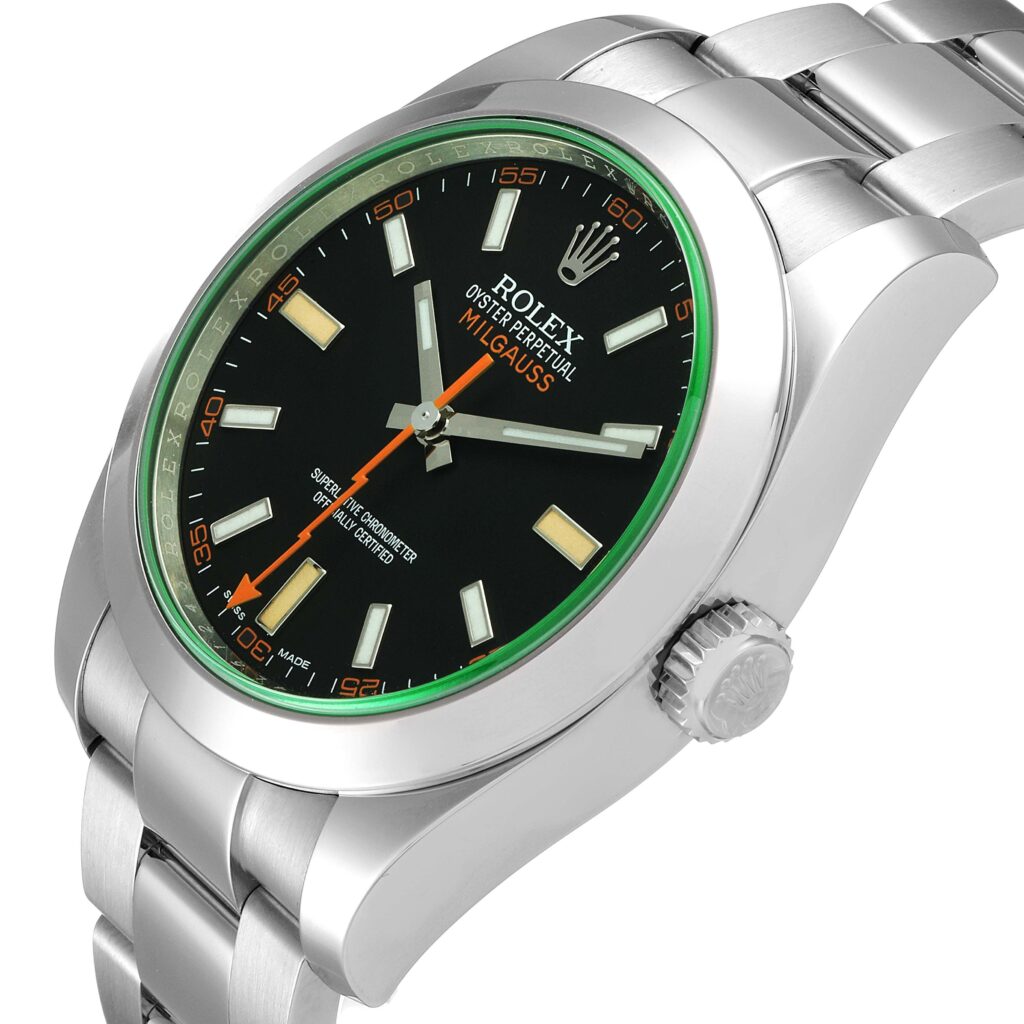
A Different Kind of Rolex: The Milgauss 1019
While modern collectors argue over bezel colors, the Rolex Milgauss 1019 sits in an entirely different category – one defined not by aesthetics or travel romance, but by scientific necessity.
Produced from 1960 to 1988, the 1019 represents Rolex at its most restrained. It abandoned the visual drama of earlier Milgauss references in favor of a clean, almost clinical design. At the time, that restraint worked against it commercially. Today, it’s exactly what makes it so compelling.
Built for a Problem Few People Had
The core issue was magnetism. In environments filled with electrical equipment, laboratory instruments, and early nuclear research systems, magnetic fields could disrupt a mechanical watch movement by affecting the hairspring.
Rolex’s solution was elegantly industrial: a soft-iron inner cage surrounding the movement, effectively creating a Faraday-style shield. Combined with a modified Caliber 1580 and anti-magnetic components, the watch could withstand magnetic exposure up to roughly 1,000 gauss.
It wasn’t flashy engineering. It was practical engineering taken seriously.
The CERN Connection and the “Lumeless” Dial
Standard luminous materials of the era relied on tritium, which – while relatively safe for wearers – interfered with sensitive scientific instruments. At CERN, that interference wasn’t acceptable.
Rolex responded by producing so-called “CERN dials,” stripped of luminous material entirely. The result was a stark, almost austere dial layout with black-painted markers and hands. Some versions simply read “SWISS” at the bottom, marking the absence of tritium.
These non-luminous variants are now among the most sought-after Milgauss references. Their appeal lies not in decoration, but in absence.
Design That Refused to Compete
Compared to contemporaries like the fake Rolex Submariner or GMT-Master, the 1019 looks almost hesitant. No rotating bezel, no sporty markings – just a smooth 38mm Oyster case and a polished bezel that feels more dress watch than tool watch.
Even the signature lightning-bolt seconds hand from earlier Milgauss models was removed, replaced by a simple red arrow tip. The overall effect is minimal, but not in a modern design sense. It’s minimal because everything unnecessary was already removed.
That decision is exactly why the watch struggled commercially when it was new. It didn’t compete for attention. It didn’t try to.
Why It Matters Today
The irony is that what once made the 1019 difficult to sell is what now defines its value. It wasn’t designed to impress collectors decades later. It was built for a narrow, highly technical purpose – and that purity is what makes it compelling today.
In many ways, the Milgauss 1019 feels closer to an engineering tool than a luxury object. And that distinction is exactly why it stands apart in the Rolex vintage landscape.
The GMT-Master II Pepsi and Batgirl represent two sides of modern Rolex: heritage-driven expression versus understated versatility.
The Milgauss 1019 sits outside that conversation entirely. It doesn’t compete – it simply exists, shaped by a problem most watches were never meant to solve.